
2025: An evolutionary year for OOH
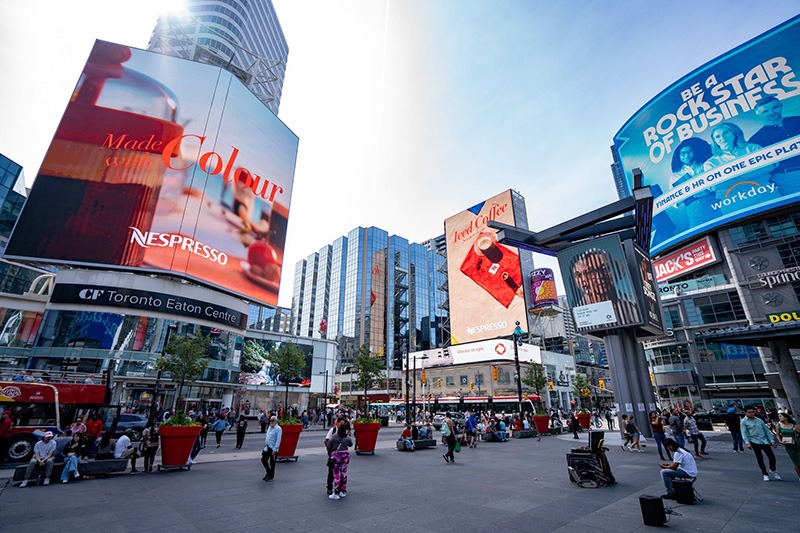
A medium defined by its ability to connect brands with audiences in shared, real-world spaces that drive engagement, out-of-home (OOH) is one of advertising’s most storied channels. Despite the market shifts it’s faced over the years, the industry has adapted to endure the test of time. 2025 proved no exception, marking another key chapter in OOH’s evolution between the growth of in-store media, the introduction of more automated transactional processes, and the smarter use of data and dynamic creative across campaigns.
These developments helped elevate the medium’s profile among media buyers and set the stage for new growth in 2026, but they also helped to drive new conversation around OOH’s full-funnel potential. As we prepare to turn the page on 2025 and head into a new year, it’s no surprise that more media buyers are eyeing OOH as they start planning around several tentpole events scheduled for 2026. All signs point toward an exceptional year ahead for the industry.
In-store media network barriers fade
One of the biggest areas driving new growth in OOH is in-store media. In and around retail environments, signage has become a powerful tool in the rapidly evolving retail media network (RMN) toolbox. As shopper expectations shift and RMNs gain traction, advertisers are rethinking how they can leverage in-store media to bridge the physical and digital worlds.
This is largely because shoppers move through different channels quickly—browsing and comparing products online and across consumer electronics, often before making their final decision in-store. In-store media can influence these decision-making moments, allowing brands to interact with consumers at the point of final purchase. Digital screens at entrances, point-of-sale (POS) signage, and proximity-based displays can extend the impact of larger RMNs. They offer advertisers visibility during a pivotal moment in the purchase journey while also enabling retailers to enhance the shopper experience.
Measurement advances are also boosting the value proposition of in-store media networks. Brands can now attribute in-store OOH exposure to outcomes, like sales uplift, tying campaigns directly to business results. This valuable opportunity not only raised more interest in in-store media from consumer packaged goods (CPG) brands this year but also enabled endemic and non-endemic advertisers to reach consumers with more contextual relevance during the shopping experience.
Thankfully, in-store media networks became less complicated for retailers to stand up, manage, and monetize this year. Technology developers like Broadsign also provided insights into how retailers can build more open networks that can scale.1 More open infrastructures maximize the use of third-party technologies without the constraints of leveraging an all-in-one provider or the costs and resources required to build a network from scratch. Plus, they are easier to scale to take advantage of emerging innovations. We only expect to see more in-store media networks launch in 2026, and both retailers and advertisers to start unlocking their full potential.
OOH transactions become more automated
If artificial intelligence (AI) is the future of ad efficiency, automation is the foundation OOH needs to get there. While programmatic digital out-of-home (pDOOH) has brought significant progress, it still represents only a fraction of total spend. Programmatic benefits have also primarily been confined to digital screens, while static OOH, which accounts for the majority of available inventory, remains tougher to buy.
Securing OOH placements directly often requires a lengthy, manual process—multiple negotiations, manual spreadsheets, and multiple back-and-forth exchanges with media owners. This drawn-out practice is one of the most significant barriers keeping OOH from competing on a level playing field with other digital channels.
As agencies faced increasing pressure in 2025 to do more with less, automating OOH transactions quickly became necessary. It became clear that freeing strategists from manual booking processes will be central to allowing them to focus on higher-value activities like creative ideation, measurement, and client strategy. Buyers want the same ease of reserving OOH inventory that they get with omnichannel demand-side platforms (DSPs).
Technological advancements emerged in 2025 to fill this gap.2 It opened new doors for buyers to book OOH inventory ahead of a campaign using programmatic pipes. While it represented a significant leap forward for the industry, further collaboration across the buy- and sell-side is required to move the needle further. Agencies, media owners, tech providers, and industry organizations must come together to define standards and simplify workflows. We anticipate steady progress on this front in the year to come.
First-party data approaches get smarter
More advertisers turned to their own first-party data to drive precision and performance in 2025. Drawing real-time and historical data from loyalty programs, customer relationship management (CRM) systems, app interactions, and purchase history, they uncovered smarter ways to target audiences without compromising privacy. OOH ultimately benefited from this wave.
We saw more OOH campaigns driven by insights such as recent store visitors or lapsed buyers, and advertisers use that data to extend audience reach into high-traffic environments. While this may have once required custom integrations and manual workarounds, technological innovations brought it within closer reach for buying teams this year.
DSP providers, like Broadsign, launched solutions that made it easier to upload and activate data without a high barrier to entry, whether for small geo-based lists or complex CRM segments.3 This development helped to equalize data-driven OOH, opening the door for more mid-sized brands, in addition to global players.
While the industry made great progress on this front, challenges remain. Data silos between CRM and media teams still slow adoption, and perceptions of cost and complexity can deter advertisers. However, as platforms continue to simplify onboarding, the benefits are undeniable: smarter targeting, higher efficiency, and reduced waste.
Layering first-party data with third-party audience insights can also create a more holistic view of consumer behaviour, helping brands find new customers who share traits with their most valuable segments. If 2025 taught us anything about OOH’s embrace of first-party data, it’s that the industry has moved beyond broad awareness into precision-driven strategy and execution, and next year, we expect forward movement.
Demand for DCO grows
Dynamic creative optimization (DCO) is unlocking new possibilities for advertisers to capture the attention of audiences and drive brand engagement in new ways. 2025 certainly saw more campaigns leverage the practice. Linking creative assets to points like weather, time of day, audience demographics, location, and other triggers, advertisers served up ads that felt immediate and contextual and ultimately drove brand engagement.
More agencies and brands experimented with the automation of large-scale personalization, deploying hundreds of creative variations across markets with minimal manual effort. This trend gave way to campaigns that showcased how DCO can enable consistency in brand voice while still reflecting local context.
At the end of the day, DCO continued to show its value as a cost-efficient way for media buyers to stretch media budgets, ensuring ads are constantly improving every day to connect with audiences. At the same time, it enhanced ad relevance for consumers, turning OOH from a static backdrop into a connected layer of everyday life. As more brands experiment with DCO next year, campaigns will not just become more visible but also timely, adaptive, and uniquely engaging.
Planning for tentpole events starts early
Though 2025 was packed with exciting developments, much of the industry’s energy is already being directed toward what OOH is capable of in 2026. With the Super Bowl, Winter Olympics, and FIFA World Cup Championship all scheduled for next year, exciting cultural moments are a given. Given the scale and shared experiences these events present, advertisers are already laying the groundwork to deliver campaigns that capitalize on them.
Campaign planning for these tentpole events is happening earlier than ever, with brands securing prime OOH inventory in advance and exploring global cross-market activations. Advancements in programmatic and automated OOH are making it easier to execute these campaigns with the flexibility to adjust creative on the fly as circumstances shift. For media owners, the challenges and opportunities lie in preparing inventory, standardizing processes, and aligning with global buying platforms. As for buyers, it’s all about integrating OOH into omnichannel activations that span online, mobile, broadcast, and CTV.
Projections for 2026
In 2025, OOH proved a medium in transition, and one that is becoming more diverse, accessible, data-driven, and creatively agile. In-store media networks moved from concept to reality, and automation broke down accessibility barriers to OOH. First-party data powered smarter, more privacy-compliant targeting across campaigns, while DCO experimentation ensured more contextual relevance
at scale.
As these trends continue to take shape, OOH is further cementing its position in the modern media mix—not just as a traditional awareness driver, but as a channel that can deliver precision, flexibility, and cultural impact. For buyers, media owners, and tech providers, 2026 offers a chance to build on the momentum of 2025 to ensure OOH continues to thrive as one of the most innovative and impactful advertising mediums in the world.
Notes
1 Read Broadsign’s Playbook for Scaling In-Store Digital Signage Networks here: https://broadsign.com/ebooks/in-store-activation
2 Learn more about Broadsign In-Advance, a platform capability to extend and simplify traditional DOOH and OOH buys through automated trading platforms: https://broadsign.com/blog/broadsign-unveils-automated-in-advance-dooh-transactions
3 Discover the OutMoove DSP here: https://broadsign.com/outmoove
Kayla Caticchio is the content marketing manager at Broadsign.
Sign up for our newsletter
Featuring breaking news from Canada's sign and graphics industry.
Products

Read the Latest Issue

