
On site and on point: Lessons from my life in installations
I want to share some of my background and the lessons I’ve learned over the course of my career in the sign installation industry. This is not a story about overnight success. It’s a story about showing up, taking responsibility, learning from mistakes, and doing the work—even when it’s uncomfortable, inconvenient, or unnoticed.
How it all started
I began when I was just 13 years old, working for my brother-in-law. Because I was small enough to fit into bulkheads, he brought me along on neon installations. At that age, I didn’t fully understand what I was learning, but I knew I liked being part of something physical and real. I liked seeing a sign light up at the end of the day and knowing I had a hand in making it happen.
Those early jobs taught me discipline and respect for the trade. Neon work requires patience, precision, and care. You don’t rush it, and you don’t cut corners. That mindset stuck with me and became the foundation for how I approached every job afterward.
Starting my first company at 16
By the time I was 16, I decided to start my own installation company. I didn’t have a business plan or investors. I had $100 for business cards and an old, borrowed van filled with my brother-in-law’s tools and ladders. Every day, I drove from shop to shop, walking into sign companies, introducing myself, and leaving a card.
At the time, installers were in high demand. If you were willing to work hard and show up, there was opportunity. Before long, I was busy enough to buy my first bucket truck for $7,500.
That truck had character. I used to joke that it was “self-cleaning”—there were so many holes in the floor that anything left down there eventually fell out. It wasn’t pretty, but it worked, and it represented something important to me: progress.
Lessons from running a small installation business
Running a small installation company taught me what self-employment really looks like—not the version people talk about, but the reality.
The challenges were real:
- You are fully responsible for finding your own work.
- Trucks, tools, fuel, repairs, and insurance all come out of your pocket.
- Certifications, safety training, and compliance fall on you.
- You do the physical labour yourself.
- You also handle invoices, collections, bookkeeping, and taxes.
Simply put: There is no safety net. If something breaks, gets delayed, or goes wrong, it’s on you.
But there were positives too:
- The earning potential was strong.
- I controlled my own schedule.
- I was building something that belonged to me.
- I learned how to be resourceful with limited equipment.
- There was pride in finishing a job properly.
Those years taught me resilience and accountability—two things no textbook can teach.
Choosing to learn instead of going it alone
At 20 years old, I made a decision that surprised some people. I shut down my company and went to work for a larger installation company. I realized there was more to learn—especially about large-scale projects, teamwork, and systems.
That decision paid off. I learned how to operate within a team, how to co-ordinate complex installs, and how larger companies manage logistics and risk. It also showed me the importance of communication and trust when multiple people are relying on one another to get a job done.
The job that changed everything
One job truly changed my career. I was asked to install eight signs at Blenz Coffee—overnight, on Christmas weekend. No one else wanted it. I said yes.
I was used to working alone and taking full responsibility, so I committed to doing the entire job myself. Around midnight, the salesperson, John Lee, stopped by to check on progress. We didn’t really know each other, and I think he wanted to make sure the site hadn’t been abandoned.
At 8 a.m., he returned and found me just finishing up. I had stayed the course and delivered exactly what I said I would.
A few months later, I was laid off due to a conflict of interest—my brother-in-law, a neon bender, landed a job that the company was bidding on. Because we were related, they let me go.
A couple of months after that, Lee called me again. He told me to go work at Tops Lighting and offered one piece of advice: “Learn everything you can.”
Growing the business
In 2002, at 24 years old, I started at Tops Lighting as an installer. At that time, the company had four trucks and eight employees. Six months later, Lee purchased the company. When that happened, all management and top installers quit. Overnight, Tops was left with four trucks and five employees, including office staff. Lee made me the shop manager.
We went door-to-door to the largest sign companies we could find; we called every contact we had; we recruited installers wherever we could; we did whatever it took to keep the company moving forward.
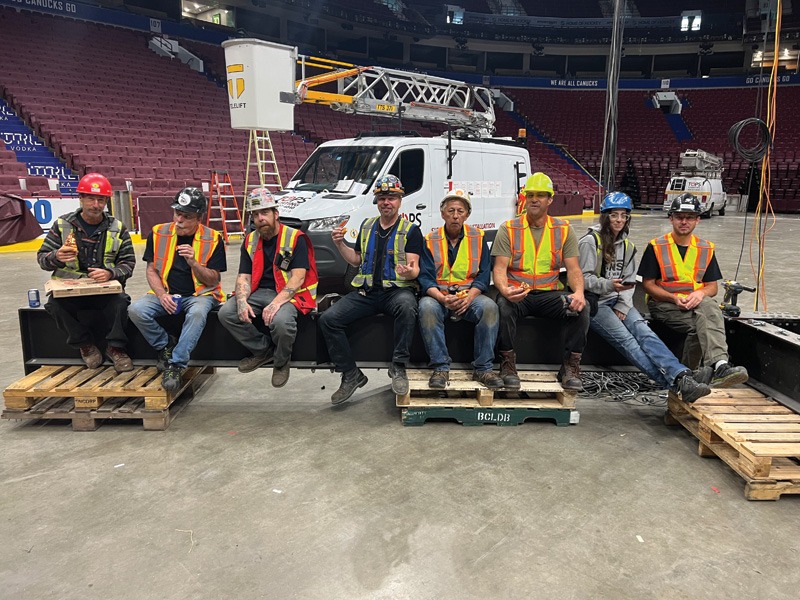
It wasn’t easy, but we grew Tops Lighting at roughly 25 per cent per year. I treated the business as if it were my own. Over time, Lee recognized that commitment and made me his partner.
Together, we grew Tops Lighting into one of the largest installation companies in Canada, operating nearly 100 trucks and servicing six provinces and territories: B.C., Yukon, Calgary, Alta., the Northwest Territories, Winnipeg, Man., and Ottawa, Ont.
We also built a fly-in service, allowing us to install and service signs in remote locations across Canada.
What I learned along the way
Some lessons only come from experience:
- If you say you’ll complete a job, do everything possible to finish it.
- Work as if the company is your own.
- Always answer your phone. If you don’t, someone else will.
- Respond to clients quickly—they have people to answer to.
- Bring solutions, not just problems.
The realities of running a large installation company
Growth brings its own challenges:
- Managing a large fleet of trucks
- Scheduling and dispatching crews
- Maintaining equipment
- High overhead costs
- Staffing and training
- Keeping certifications current
- Protecting your reputation
- Handling job overruns and on-site issues
Every day brings new problems to solve. But those challenges are balanced by meaningful rewards.
The positives
- Installing large, high-profile projects
- Building a strong installation community
- Providing stability for employees and their families
- Seeing tangible results of years of effort
A project I’ll never forget: Rogers Arena
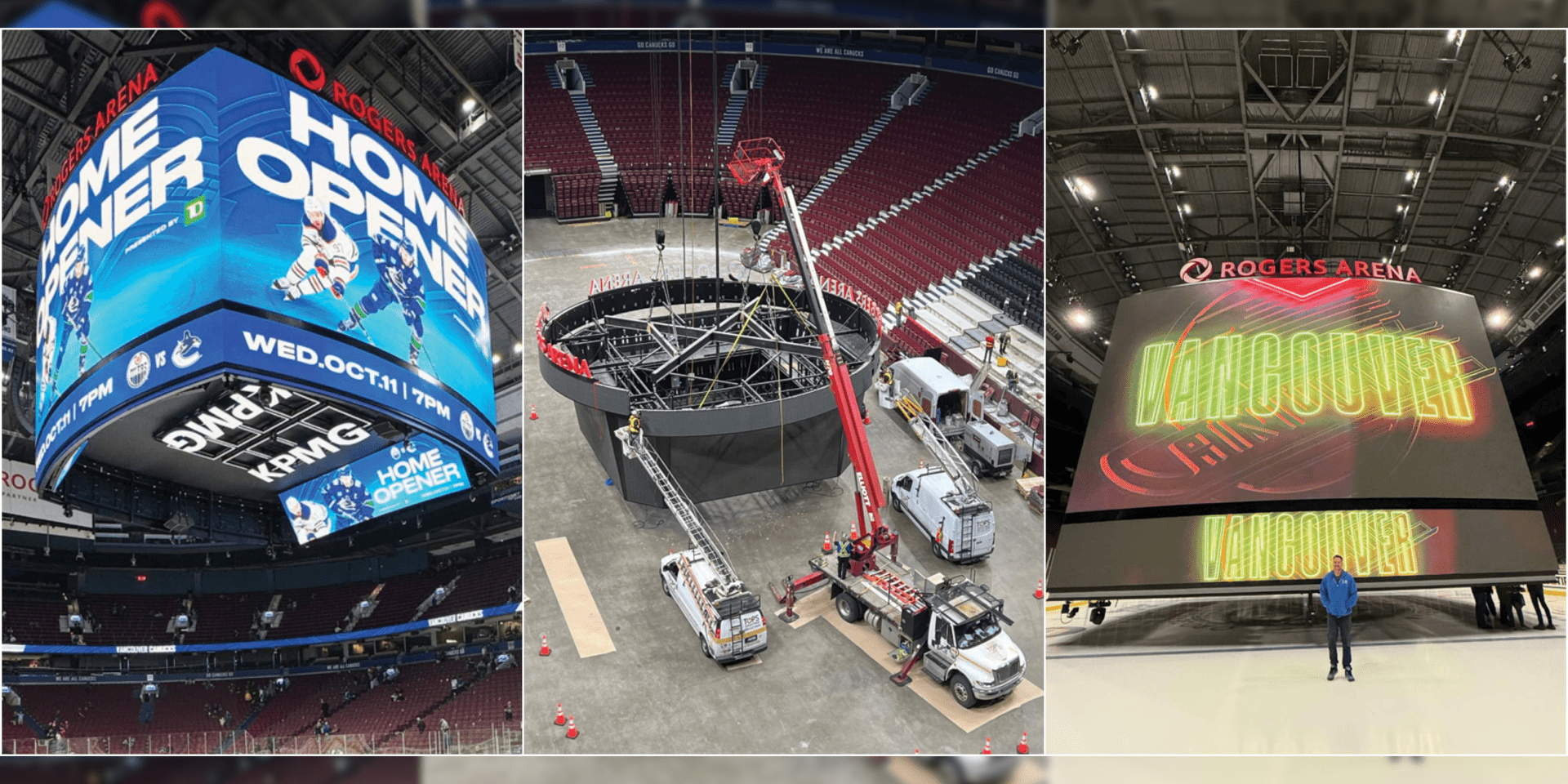
One of the most memorable projects of my career was Rogers Arena in Vancouver, B.C.
We installed all the LED ribbon boards and the largest LED centre-hung scoreboard in the National Hockey League (NHL). What was supposed to be a two-month project quickly became far more complex. Concert bookings doubled, additional events were added, and the NHL season was scheduled to begin just two weeks after our planned completion.
To make matters worse, the port went on strike, and all materials were stuck in the shipyard. We began removals without having the new product on site, hoping it would arrive on time.
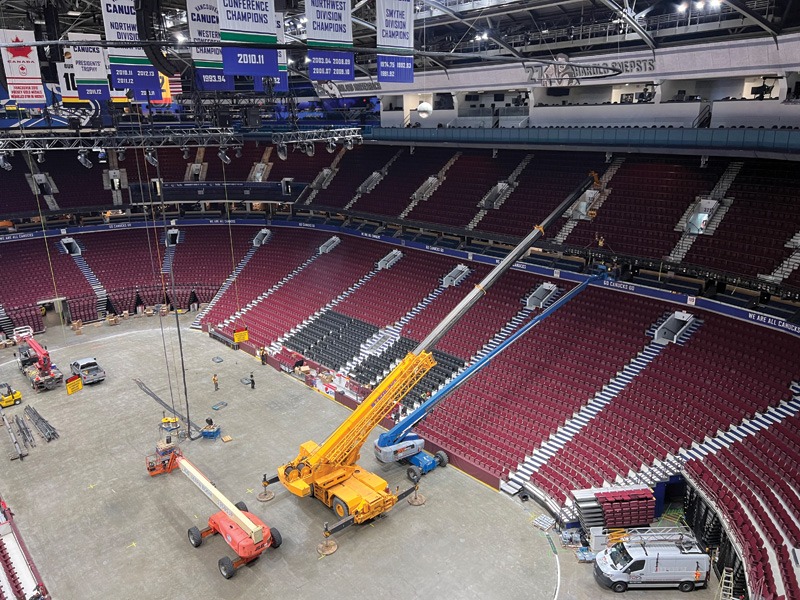
Access was minimal. Due to underground parking and water pipes beneath the ice, the crane could only be positioned in six precise locations—within 304.8 mm (12 in.)—directly over structural columns.
When the materials finally arrived, we were already behind schedule. We shifted into another gear, sending 12 installers to work 12–18-hour days. Every week, a concert forced us to fully demobilize, secure the structure, and then remobilize after the event.
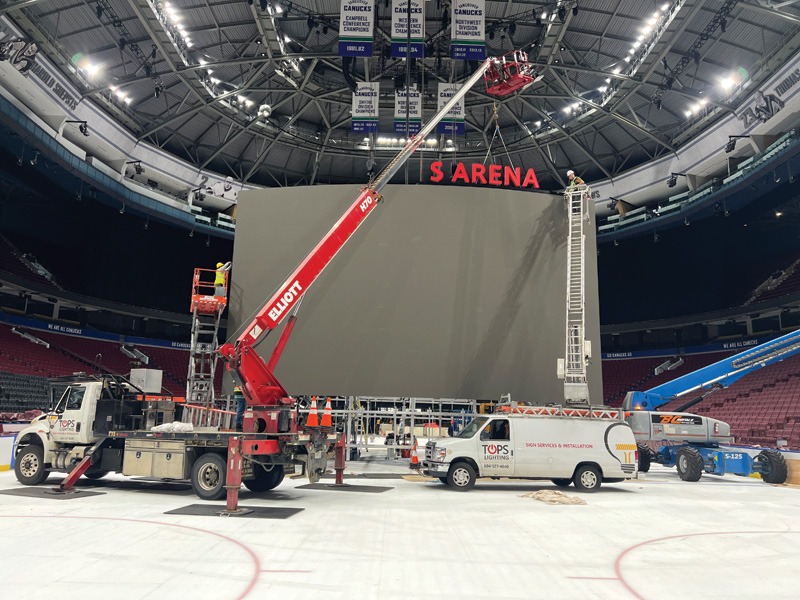
We finished the job just two days before the first NHL game. When the completed scoreboard was lifted, you could feel the building flex—but that’s exactly how it was engineered to perform.
To this day, when I attend a game and look up, I feel immense pride in what our team accomplished.
Final lessons
Be kind to your customers—without them, you have no business.
- Do what you say you’ll do.
- You can’t buy your reputation; you must earn it.
- Never poach clients—the industry is small.
- Watch cash flow carefully.
- Don’t let receivables grow unchecked.
- Be cautious with truck payments—cash is best
when possible.
The sign industry is one of the few industries where you can drive down the road and see your work. That’s something to be proud of. We need to support one another and keep this industry strong. I am truly thankful for the friendships, partnerships, and lessons I’ve gained along the way.
Kris Voros is the co-owner of Tops Lighting Sign Services and Installation.
Sign up for our newsletter
Featuring breaking news from Canada's sign and graphics industry.
Products


Read the Latest Issue
