
The finishing gap: Closing the loop in POP production

The rise of social commerce, the shift to digital media, and a greater focus on building omni-channel customer experiences mean brands and retailers are having to work harder to capture the attention of customers (and keep it), both in stores and at events and exhibitions. Displays need to be eye-catching, informative, and most importantly, stand out against the sea of competitors all vying for the same attention.
As ever, one of the best ways to achieve this is through high-quality, impactful displays that cut through the noise, reach the desired audience, and clearly relay the intended message. But with campaigns moving faster and more reactively as brands and retailers work to keep pace with fleeting trends and deliver timely marketing moments, signage businesses are having to adapt to meet demands for faster turnarounds, shorter runs, and higher volumes than ever before.
Trends driving the POP market
A rise in experiential marketing, continued advancements in printing technology, and growing consumer demand for engaging, eye-catching in-store and in-show experiences are all key drivers behind the growth of the point-of-purchase (POP) displays market. According to Market Research Intellect, the POP display market was valued at $6.81 billion in 2025 and is forecast to grow at a compound annual growth rate (CAGR) of 15.8 per cent between 2026 and 2033.1
While corrugated board continues to account for the largest share of POP displays2 due to its cost-effectiveness, versatility, and recyclability, soft signage is emerging as a fast-growing segment of the market. Lightweight, durable, reusable, and visually impactful, soft signage is increasingly being adopted by brands looking to create standout displays for retail environments, events, and trade shows. The global soft signage market is expected to grow at a CAGR of 7.8 per cent to $66.4 billion by 2035. In North America, in particular, strong retail and live events sectors are driving increased demand for fabric-based large-format graphics and tension displays.

The flexibility of textile graphics also makes them well-suited to POP applications, where short-term campaigns, seasonal promotions, and frequent updates are common. Typical soft signage POP formats include hanging banners, floor, window, and wall graphics, fabric tension displays, and flags. Among these, banners continue to lead the market, accounting for a 34.7 per cent share of global soft signage usage in 2025.
The need for automation
POP displays demand, quick turnaround times, and even faster reaction times to shifts in trends, peaks due to short-term campaigns, seasonal demand, and creative changes. To stand out, companies need to keep pace with this demand, and a key element is removing bottlenecks that could slow production. While printing speeds and pre-press software evolve at a significant pace, processes such as media loading and handling, and finishing of jobs by grommeting, cutting, and welding or sewing hems can often be where production slows down. Essentially, no matter how fast their printing equipment is, print shops can only be as fast as their slowest point.
As brands demand quicker turnarounds and flawless displays, the ability to streamline and automate finishing workflows is becoming a defining competitive advantage. This was reflected in a recent Alliance Insights report, Exploring Automation in Wide-Format Printing, where 30 per cent of respondents reported turnaround time as a critical challenge due to rising demand for quicker delivery. Another 30 per cent cited manual workflow bottlenecks, including finishing, as a leading cause of slow production. Labour shortages can exacerbate this further, with 44 per cent of respondents citing labour availability as a significant concern.
What makes finishing a common bottleneck?
Turning a printed substrate into a graphic that is ready for installation typically involves quite a few steps, even for the simplest products. For most operations, large-format print finishing involves predominantly manual processes, and in addition, the materials being finished are typically large and cumbersome to handle. Processes such as cutting media to size, welding hems, adding grommets, and sewing banner hems or pole pockets for products like flags can be time-consuming even for skilled operators. Plus, when manual processes are rushed, it can result in errors, leading to even longer production times due to the need for reprints.
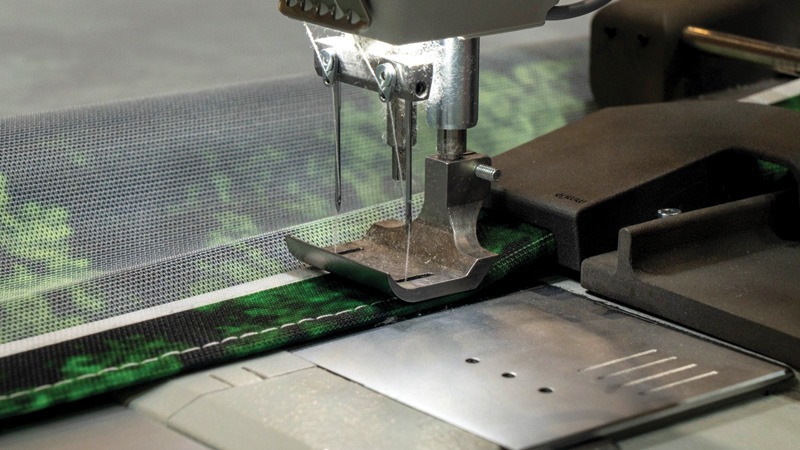
Large-format finishing automation can speed up production by turning these time-consuming manual tasks into streamlined automated steps and reducing the pressure on lean production teams by enabling single-operator production. However, finishing is often overlooked when it comes to investment and upgrades, with attention often turning to the fastest new large-format printer, software upgrades, or prepress automation instead.
A holistic approach
When assessing the need for large-format print finishing automation, it’s important for print shops to take a holistic view of end-to-end production. By walking through the journey each type of project takes through your print shop, printers can often identify opportunities for the kinds of incremental improvements that will enable them to keep growing. From loading and moving media rolls to welding, sewing hems, and adding grommets, through to packaging and shipping the finished product, examining the steps taken as each product moves through the shop helps to identify areas that are causing bottlenecks and could benefit from automation. Even incremental adjustments can have a significant impact on wider production times.
Another consideration could be assessing how many operators are currently handling each stage of finishing and which of these processes could be streamlined with automation, as well as any equipment that could improve workspace efficiency, such as media storage racks and lifters or all-in-one automated banner finishing systems.
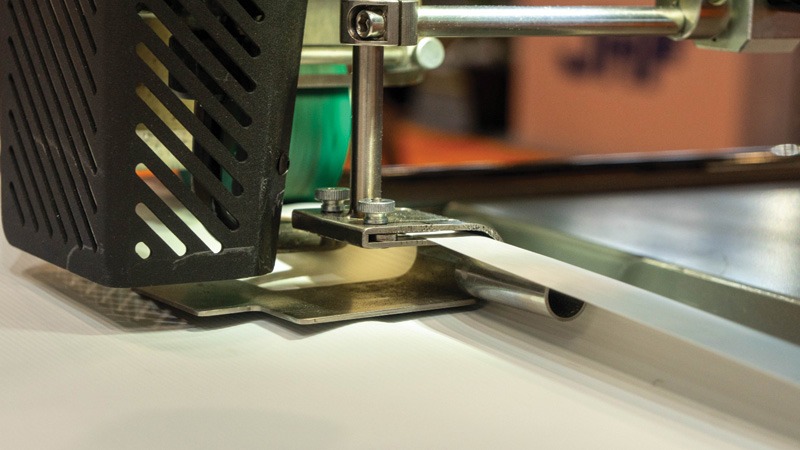
Ultimately, investments in automation aren’t about replacing operators or eliminating steps; they are about freeing up capacity, speeding up production, or improving profitability. More than this, by investing strategically, you can also enable long-term business growth by changing the kinds of orders you can handle or pivoting to open up a new market segment.
Reducing bottlenecks
So, what does large-format print finishing automation look like in action? For many printers, the most effective approach is to tackle one production step, or bottleneck, at a time. Take hanging fabric banners, for example, a format that shares many of the same finishing demands as fabric backdrops, retail wayfinding, and textile window displays. Upgrading from manual grommeting to a semi-automatic or fully automatic grommeting system can significantly increase throughput while ensuring consistent, installation-ready results across repeat formats. Similarly, conveyor-assisted welding or sewing systems can streamline the production of long hems, pole pockets, and seams, which are common across a wide range of soft signage applications. Automated cutting tables further improve accuracy and repeatability, particularly when producing multiple panels or sets for multi-site retail rollouts.
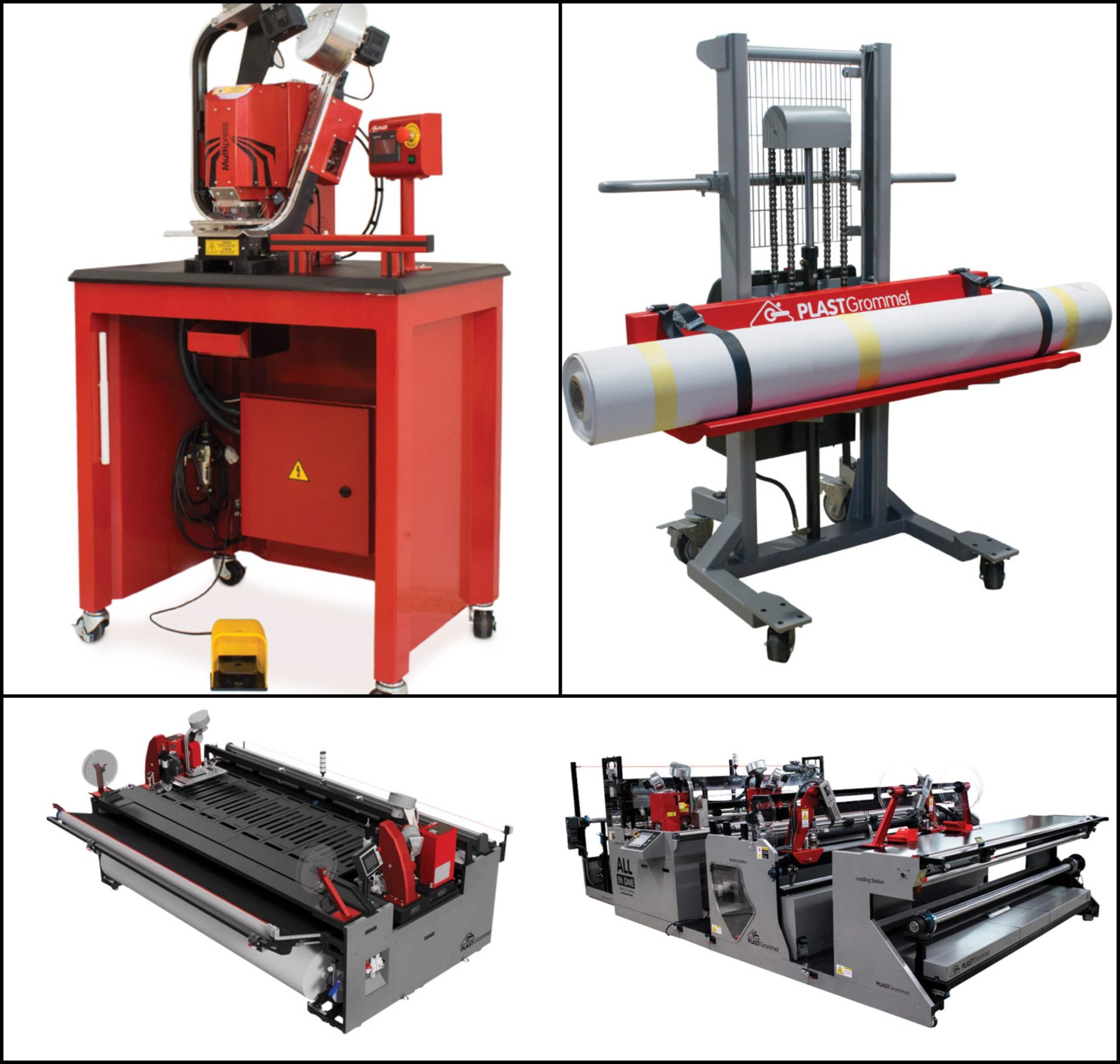
For some print shops, going bigger may be the investment that opens up their next phase of growth. A fully integrated finishing line that combines cutting, welding, and grommeting in a single workflow can streamline media handling and ensure precise grommet placement while reducing the overall footprint on the production floor. A hybrid system that integrates both welding of polyvinyl chloride (PVC) banners and sewing automation for textile products in a single system, along with cutting and grommeting, can also be beneficial to print shops that are producing both traditional PVC banners and textile displays but the demand for each material type doesn’t guarantee investment in two separate platforms.
By prioritizing large-format print finishing alongside software and hardware upgrades and thinking about the end-to-end process of all of their products, print shops will better position themselves to capitalize on opportunities within the POP market and avoid risking being left behind.
Notes
1 Read the Market Research Intellect analysis here: https://www.linkedin.com/pulse/point-purchase-display-market-research-insights-tewcc/
2 Learn more about the Archive Market Research overview here: https://www.archivemarketresearch.com/reports/point-of-purchase-display-pop-display-105846
3 Discover the growth of the soft signage market here:https://www.futuremarketinsights.com/reports/soft-signage-market
Rafa Menéndez is the head of sales and marketing at PLASTGrommet.
Sign up for our newsletter
Featuring breaking news from Canada's sign and graphics industry.
Related Products
Read the Latest Issue

