A signmaker’s guide to modern channel letters
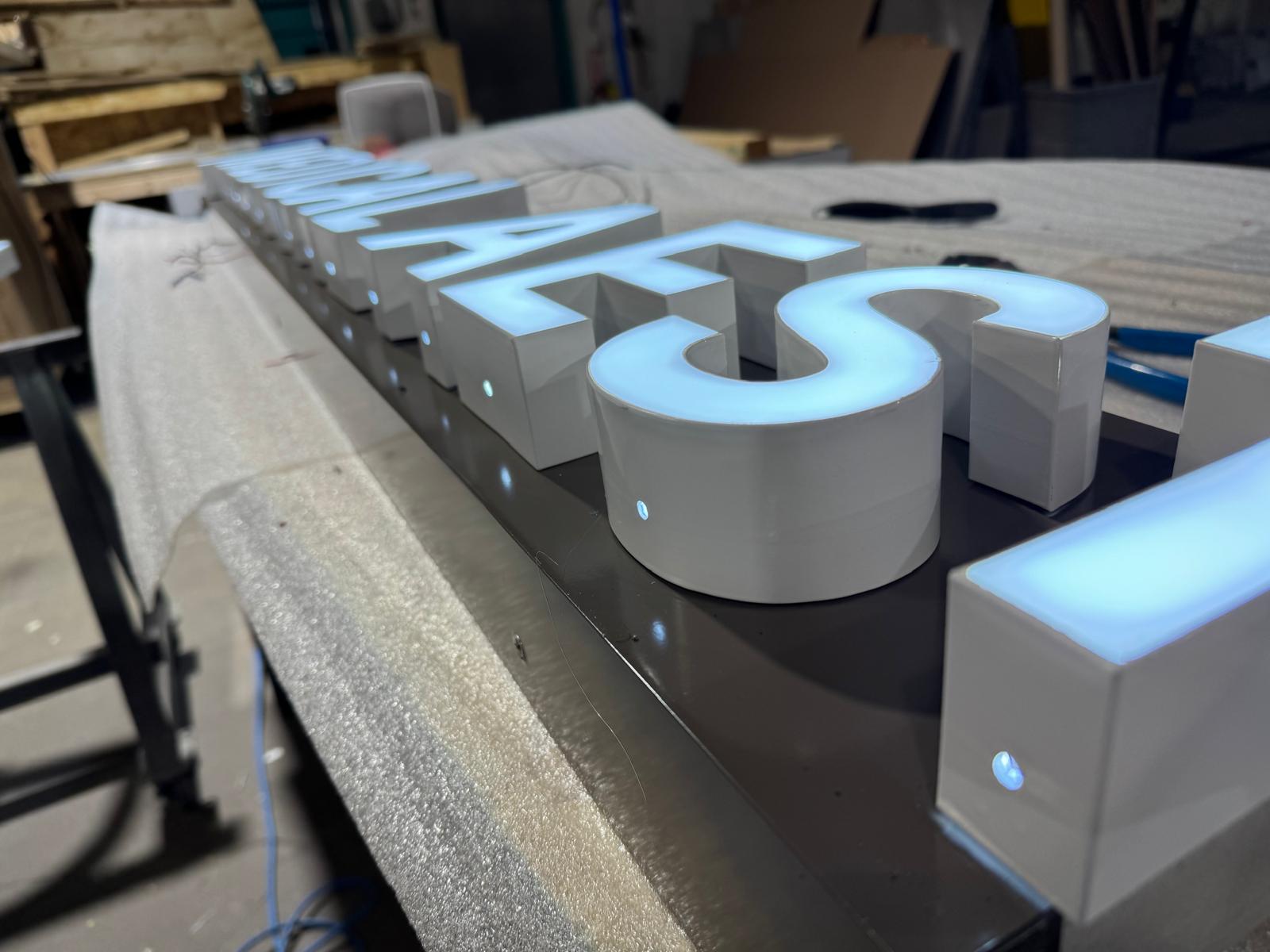
Channel letters are the storefront staple of North American retail identity. They are more than a signage format; they are the backbone of branding across commercial strips, restaurants, national retail chains, independent boutiques, and corporate campuses.
Channel letters are a type of illuminated sign in which each letter or character is individually fabricated as a three-dimensional enclosure with internal illumination. Channel letters use separate, self-contained letterforms, each housing its own light source, to create visual depth, spacing, and dimensionality.
Manufacturing Materials
When constructing channel letter signs, the choice of materials plays a pivotal role in determining their appearance, durability, and overall effectiveness.
The most commonly used materials include aluminum, stainless steel, acrylic, polycarbonate, polyvinyl chloride (PVC), and composite materials, each offering unique benefits to suit different sign projects.
Because these materials are highly customizable, you can tailor colours, fonts, and shapes to match any brand. Further, to fabricate channel letters, it is necessary to use adhesives, mechanical fasteners, LEDs, and vinyl.
Types of channel letters
Based on the channel letter appearance, we can divide them into a few different styles:
- Front-lit: The most common style, front-lit channel letters and logos use internal lighting to illuminate the translucent front (also known as the “face”) of the element.
- Halo-lit/reversed illuminated: They have an opaque front, and their internal illumination towards the translucent back casts a glow (also known as “halo”) on the mounting surface.
- Open face: These elements have no front or a clear front, exposing the neon, bulls, or LED inside.
- Side illuminated: This style of channel letters and logos uses internal lighting to illuminate its translucent sides (also known as “returns”).
- Combination: These styles can be combined, for example, front and halo lit, or front and side lit.
Channel letter fabrication
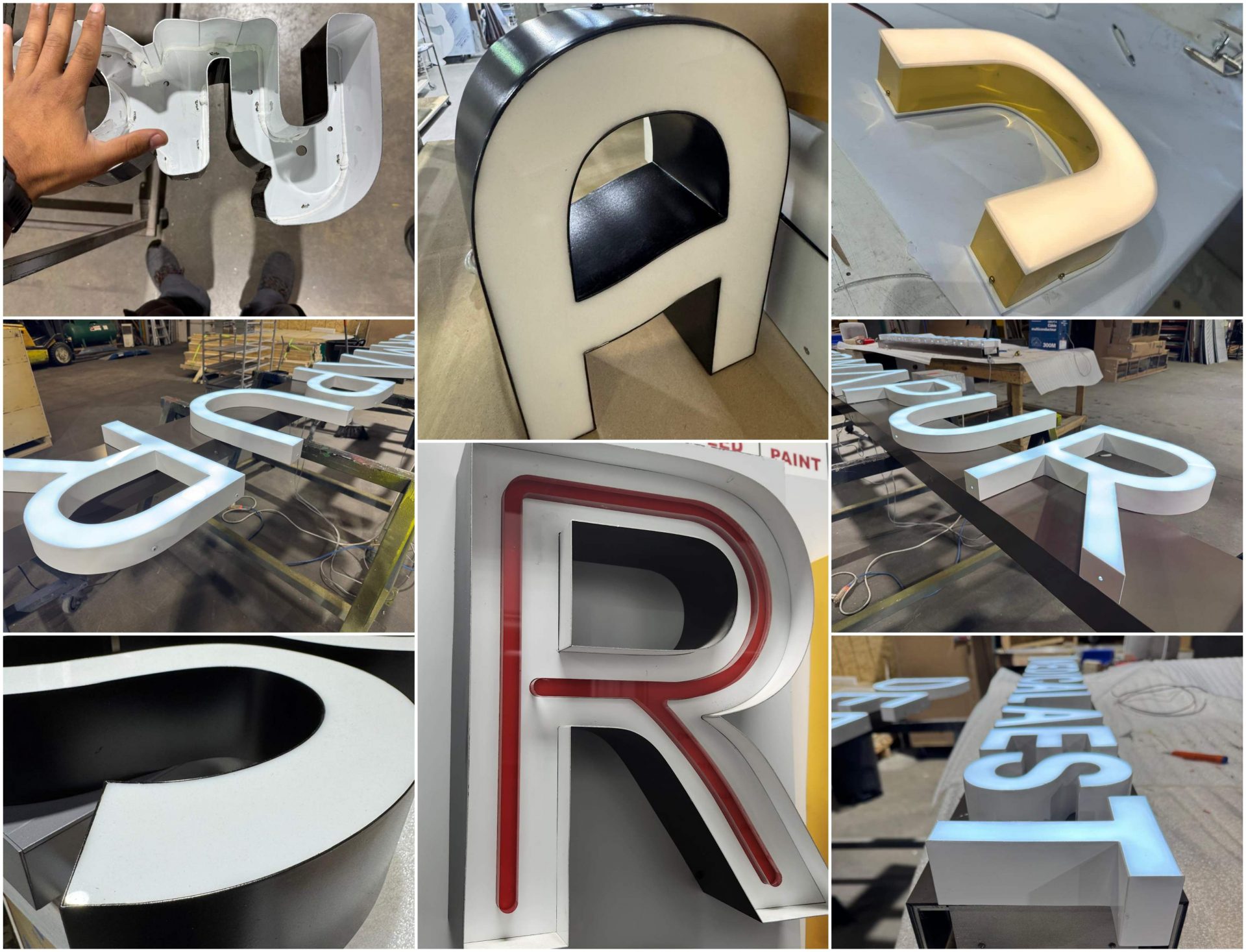
Channel letters consist of the following parts:
• Face: For front-lit letters, a translucent material (typically polycarbonate or acrylic) is used to diffuse the light. For halo-lit letters, the face is opaque (usually aluminum or stainless steel). These materials are cut into shape.
• Return: The side of a channel letter is known as the “return”. The size of the return will dictate the depth of the letter. They are usually made from aluminum, stainless steel, or plastic for side-illuminated letters. The returns are bent and shaped to follow the channel letter’s contour.
• Backs: For front-lit letters, an opaque material (typically aluminum or composite material) is used. For halo-lit letters, the back is translucent (usually polycarbonate) to diffuse the light. These materials are cut into shape and have holes for mounting hardware and wiring.
• Light source: Channel letters are usually illuminated with LEDs; in some instances, decorative bulbs or neon lighting are also used. The LEDs are placed inside the channel letters, in any of the surfaces (faces, returns, or backs), depending on the illumination needs.
Assembly of channel letters
All these parts need to be attached. The faces are connected to the top of the returns, and the backs are connected to the bottom.
For front-lit letters, the most common method is notching and flanging. The flanging in the bottom of the returns allows you to attach the backs to the returns with a mechanical fastener (screws, staples, or rivets) through the back of the letter. To close the letter with the face, a trim cap or retainer is glued to the face, facilitating attachment to the returns with screws through the side. Lastly, the internal illumination (commonly LEDs) is glued to the back, facing the face. The way these letters are assembled resembles a show box with a removable lid. This allows for the letters to be serviceable.
In addition to the traditional front-lit channel letter method, channel letters without retainers or trim caps (trimless/edgeless) are gaining popularity due to their sleek look. There are multiple ways to manufacture letters without a trim cap. One way is to attach the returns to the sides with screws, routed into an internal lip, routed into thicker faces. There are also assembly systems that use specific returns profiles, clips, brad nails, and adhesives. These assembly systems facilitate the manufacturing of these channel letters and eliminate the need for visible fasteners.
For halo-lit or reverse illuminated letters, the assembly changes completely. The opaque faces are welded or glued to the returns. Aluminum angles are attached to the translucent backs so that they can be attached with screws through the sides of the returns. In this case, the whole face and returns would be the removable part to allow for servicing. Additionally, the internal illumination can be installed in any of the internal surfaces of the letter, depending on illumination preferences.
Mounting options for channel letter signs
In addition to the assembly and materials used for channel letters, the construction of channel letter signs involves selecting the appropriate mounting method.
Depending on the installation requirements, the mounting surface can be flush, in a raceway, on a backer, or a combination of these methods.
- Flush (Direct) Mount: This mount is the most common. And it gets its name because the letters mount directly to the building’s face. For backlit letters, separation from the surface is achieved with standoff spacers.
- Raceway Mount: Many property managers often request that channel letters be mounted atop a raceway. Raceways are containers that neatly and safely hold the electrical components (wires, power supply, and so on) for the individual letters. A raceway also reduces the number of holes drilled into the wall. Painting raceways to match the colour of the sign band or storefront is a common technique to ensure they blend well with brand guidelines and the surrounding architecture.
- Backer Mount: This option sees the channel letters attached through a pre-made opening in the building’s frontage or mounted atop the backer board. The electrical hardware and power supply are contained within the backer cabinet or situated behind the facade or bulkhead wall.
Modern channel letter manufacturing
Traditional craft and innovative manufacturing
Channel letter fabrication has long been a deeply hands-on craft, shaped by skilled fabricators who relied on experience, intuition, and an intimate understanding of materials from shop to shop. Each letter was a small work of art: returns were bent by hand to achieve the perfect contour, faces were carefully cut and shaped, and assemblies were pieced together on benches with glue, rivets, or tack welding. LED placement was determined through trial, careful observation, and “feel,” ensuring each letter was illuminated evenly. This artisanal process allowed for highly customized, one-of-a-kind designs, but it was labour-intensive and could introduce subtle inconsistencies between letters or across larger runs.
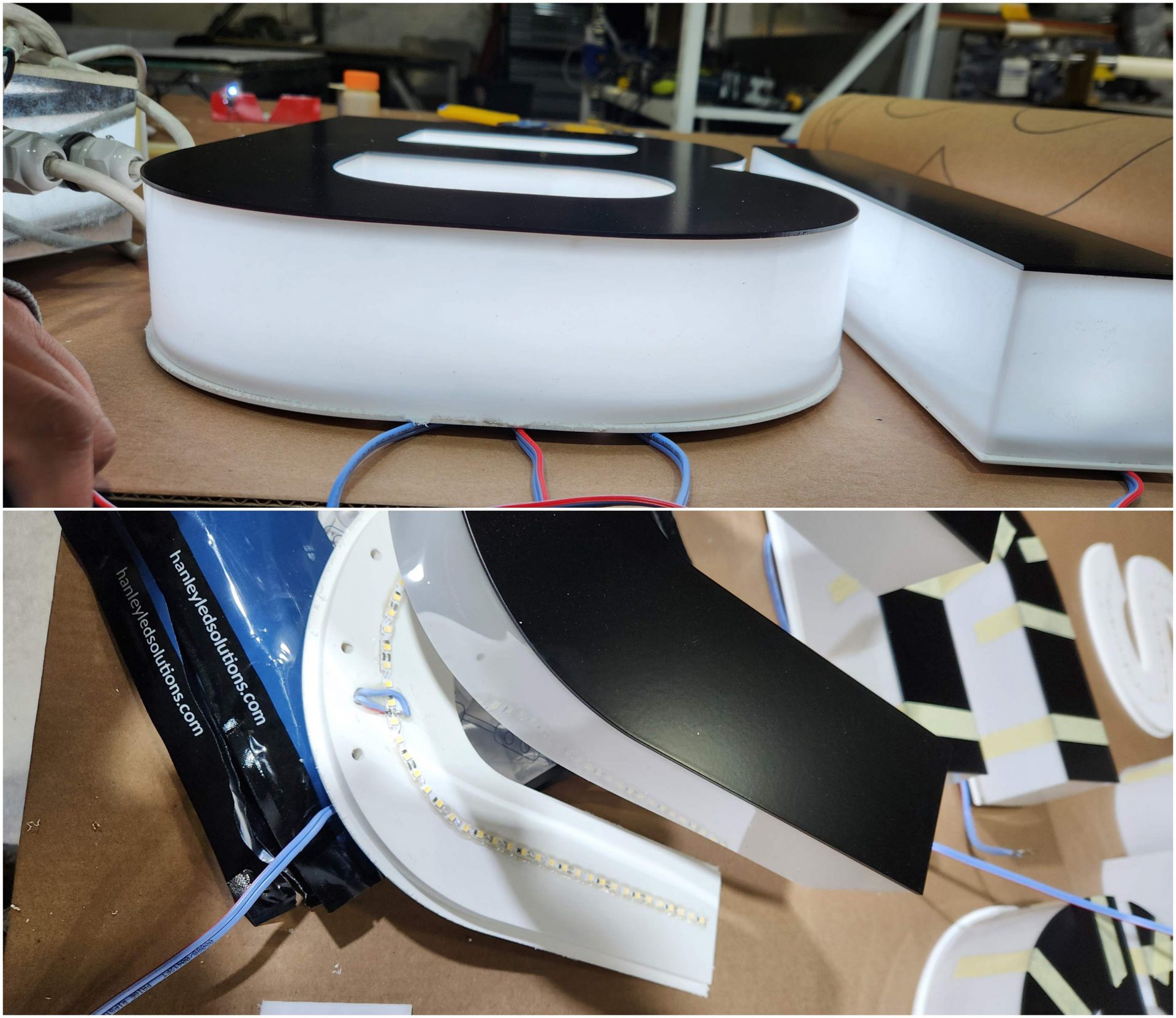
While that foundation of craftsmanship remains essential, the channel letter industry is increasingly embracing advanced, technology-driven tools that expand what’s possible. Computer-numerical control (CNC) routers and laser cutters now provide precise, repeatable cutting of metals, acrylics, and composite materials, drastically reducing human error. Modern channel letter benders streamline the shaping of returns and make it possible to produce specialty profiles that were once time-consuming or nearly impossible by hand. Even the internal lighting of letters has benefited: LEDs are brighter, more energy-efficient, and more consistent, and layout software allows designers to map the optimal placement of each module, eliminating dark spots or uneven illumination. Automated assembly tools, including riveters, staplers, and stitcher systems, reduce manual labour while maintaining the integrity and durability of the letters. Meanwhile, innovations in materials like lightweight composites or stronger, clear adhesives allow for new assembly techniques that couldn’t be achieved before.
These advances do not replace the artistry of skilled fabricators; they amplify it. Modern tools let signmakers maintain the creativity, attention to detail, and customization that have always defined channel letters, while gaining efficiency, precision, and scalability. Shops that combine traditional methods with these technologies can take on larger projects, deliver consistent results, and explore more complex designs that would have been impractical just a few years ago. Importantly, the evolution toward automation and digital workflows is not about leaving craftsmanship behind—it’s about giving artisans the tools to work smarter, faster, and with greater confidence in the final product.
The future of channel letter manufacturing
The next significant improvement in channel letter manufacturing will likely come from digital systems that continue to streamline tasks—for example, automating file (vector) preparation and setup for channel letter-making equipment, such as channel benders, CNC routers, or laser cutters, as well as LED layouts, mounting-hole positioning, and installation-pattern generation.
Additionally, new technologies have been adopted by channel letter manufacturers, such as 3D printers, which directly print returns or complete letters without the need for additional assembly. Additive manufacturing is quietly entering the channel letter landscape, particularly for indoor and short-cycle environments, lowering manufacturing cost, reducing shape and size constraints, and minimizing equipment footprint and investment. However, it is unlikely that additive fabrication replaces aluminum construction for outdoor channel letters.
Forward-looking shops are integrating digital design-to-production workflows, experimenting with additive manufacturing for indoors, and finding new ways to balance creativity with precision. The result is a dynamic landscape where tradition and innovation co-exist, offering the opportunity to elevate the craft to serve clients better in an ever-changing market.
Final thoughts
Channel letters remain one of the most versatile and enduring forms of illuminated signage, combining dimensional impact, brand flexibility, and long-term performance. While the fundamentals of channel letter construction, materials, lighting, assembly, and mounting have remained consistent, the methods used to fabricate them continue to evolve. Today’s sign manufacturers operate at the intersection of craftsmanship and technology, where traditional skills are complemented by automation, digital workflows, and increasingly precise tools.
As equipment, materials, and software continue to advance, sign shops have more opportunities than ever to improve efficiency, consistency, and scalability while preserving the quality and creativity that define great signage.
With a career in the sign industry since 2018, Gabriel Carro brings vast technical expertise and a practical understanding of automated equipment in sign manufacturing. He is currently the Operations Manager at Tekkaform Solutions, a supplier of sign-manufacturing equipment, where he oversees technical operations, equipment integration, and process development for modern production workflows. In his current role, he works closely with sign shops across North America to support equipment selection, implementation strategies, and production efficiency improvements. Carro is a member of the ISA Elite Program Class of 2025.
Sign up for our newsletter
Featuring breaking news from Canada's sign and graphics industry.
Products
Read the Latest Issue

