Dye sublimation takes on larger dimensional substrates
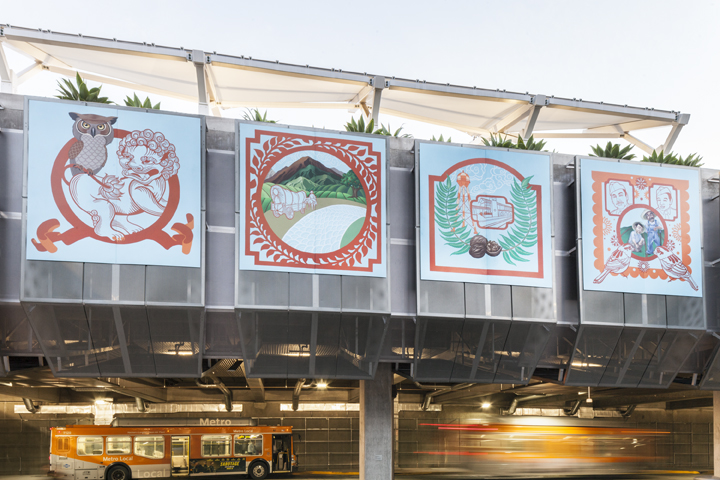
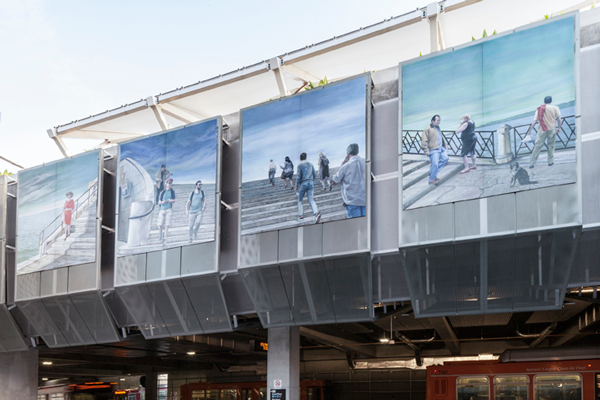 While the sign industry may be most familiar with dye sublimation in the context of fabric graphics, the process is now also being applied to larger, three-dimensional (3-D) media for architectural applications.
Dlubak Powder Coating and Design, for example, uses large ovens at its facility in Kittanning, Pa., to accommodate oversized substrates in practically any shape, allowing staff to sublimate images on ceiling panels, glass window panes and garage doors, among other architectural surfaces. The largest of the ovens is 7.3 m (24 ft) long.
First, the artwork is printed onto a dye sublimation film. Then the film is placed on a powdercoated substrate and passed through the oven, with a vacuum table keeping it in place. In addition to the permanence of sublimated images, the powdercoating process provides a hard surface layer withstands harsh environments better than conventional paint could.
The results have allowed architects to specify durable, natural-looking finishes for wall façades, skylights and other building features. Sublimated glass, for instance, is reportedly longer-lasting than stained glass.
Sublimating graphics on unusual shapes can pose challenges, so Dlubak uses a Wasatch raster image processor’s (RIP’s) tiling tools to lay out multiple graphic panels with a small overlap. This helps prevent errors when placing the printed films on the powdercoated substrates.
Software is also essential to colour management.
“I know when I click ‘print,’ the file will be reproduced accurately, with colour consistency throughout,” says Frank Dlubak, president, who started his career as a stained glass artist and has worked on more than 500 churches.
Sign up for our newsletter
Featuring breaking news from Canada's sign and graphics industry.
Popular Articles
-
1
-
2
-
3
-
4
-
5
Read the Latest Issue

